Summary:
Drycrete grounds its experience in concrete operational detail, crew size and how a job actually runs, rather than vague claims. A wet basement can come from four different causes, hydrostatic pressure, seepage, wicking, or humidity, and treating the wrong one is why some repairs don’t hold. A patched crack that reappears usually means the underlying cause is still active behind it, not that the repair failed. Drycrete’s interior-only systems address these causes without the disruption of exterior excavation.
What Helping 11,000 Homeowners Has Taught Us
Drycrete Waterproofing is a basement waterproofing contractor serving Eastern Massachusetts and Rhode Island, with more than 30 years in business and over 11,000 completed jobs. That scale shows in how a job actually runs. A typical crew is six or seven technicians working together, not one person handling everything alone, and the approach isn’t to throw one fix at every basement. Water gets into a home for different reasons, and the years have shown that treating it as a single, one-size problem is how homeowners end up paying for the same repair twice.
The Four Reasons a Basement Actually Gets Wet
Most homeowners describe their basement problem the same way: it’s wet, and they want it to stop being wet. But water gets into a basement through four distinct mechanisms, and mixing them up is the most common reason a repair doesn’t hold.
Hydrostatic pressure builds when the soil around a foundation becomes saturated, usually after heavy rain or spring snowmelt, and has nowhere to drain. That water pushes against the foundation walls and floor with real force, and eventually finds the weakest point to get through. Seepage is water finding an actual path in, through a crack, a gap where the wall meets the floor, or a deteriorating joint, rather than being pushed through solid material. Wicking happens without any visible opening at all. Concrete is porous, and it can draw moisture up from wet soil the same way a paper towel draws up a spill, leaving walls damp or a floor that never quite feels dry even with no obvious leak. Humidity is different from all three because it isn’t water intrusion at all. It’s airborne moisture building up in the space itself, often worse in summer, and it’s the reason a basement can smell musty even when the floor is bone dry.
Knowing which of these four is actually happening changes what gets fixed and how. A repair aimed at seepage won’t touch a humidity problem, and no amount of dehumidifying will stop hydrostatic pressure from finding its way in somewhere else.
Why the Same Crack Keeps Coming Back
A crack that gets patched and reappears a year later usually isn’t a sign the patch failed. It’s a sign the patch fixed the crack without fixing what caused it. If hydrostatic pressure or wicking is still active behind that wall, the concrete is still under the same stress that caused the first crack, and sealing the surface doesn’t relieve any of that pressure.
That’s part of why every crack repair carries a lifetime guarantee. The repair itself is built to hold, but water problems in a home don’t always announce themselves as a single crack. Sometimes fixing one crack surfaces a second issue nearby, or reveals that the real problem was never the crack at all, but the water pressure that put it there in the first place.
Interior Systems Solve Interior Problems
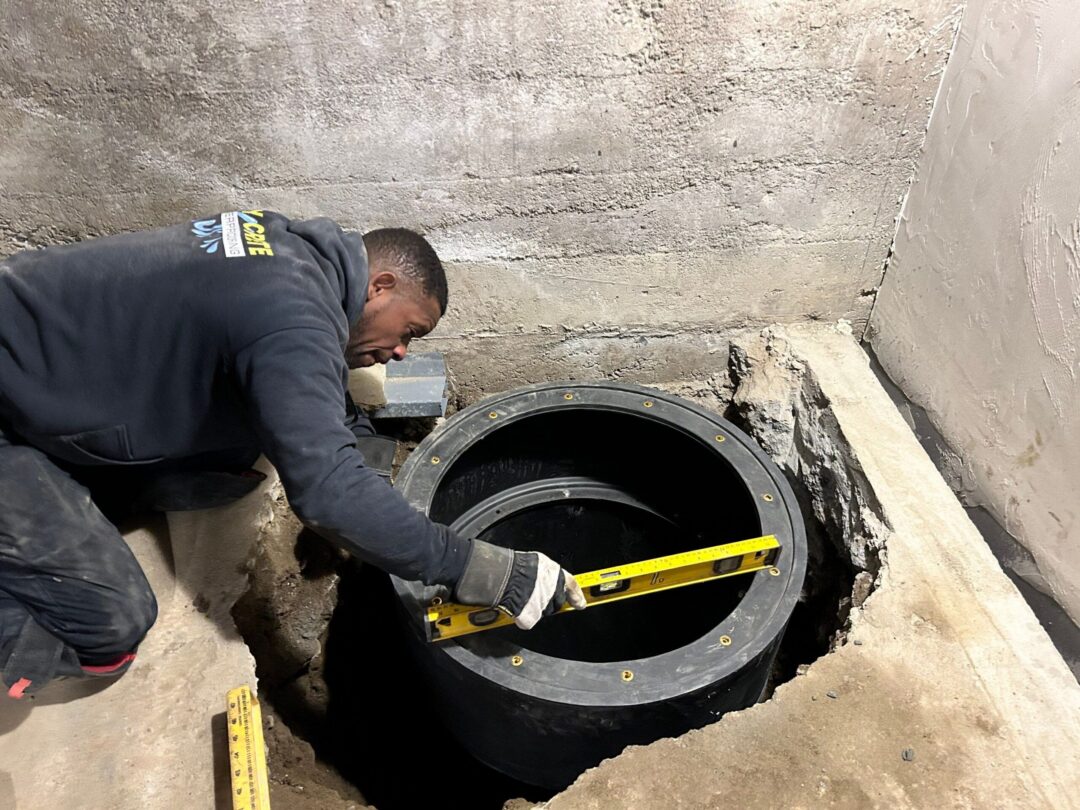
Drycrete works almost entirely inside the basement, not outside digging up the yard. That’s not a limitation, it’s the reason the work can get done in a day or two instead of a week, without tearing up landscaping or waiting on weather to cooperate with an excavation. An interior drain system, sump pump, and vapor barrier address water once it’s already found its way toward the house, catching it before it becomes standing water on the floor, and managing the humidity and pressure that caused the problem to begin with.
That focus also means the systems installed are the ones actually suited to fixing water from the inside, not a scaled-down version of an exterior approach. A crew that specializes in interior work knows exactly how those systems perform over years, in real houses, because it’s what they’ve done thousands of times.
Ready for a Dry Basement?
If your basement has a water problem that keeps coming back, or one you haven’t been able to pin down, a professional inspection can identify exactly which of the four causes is behind it.