
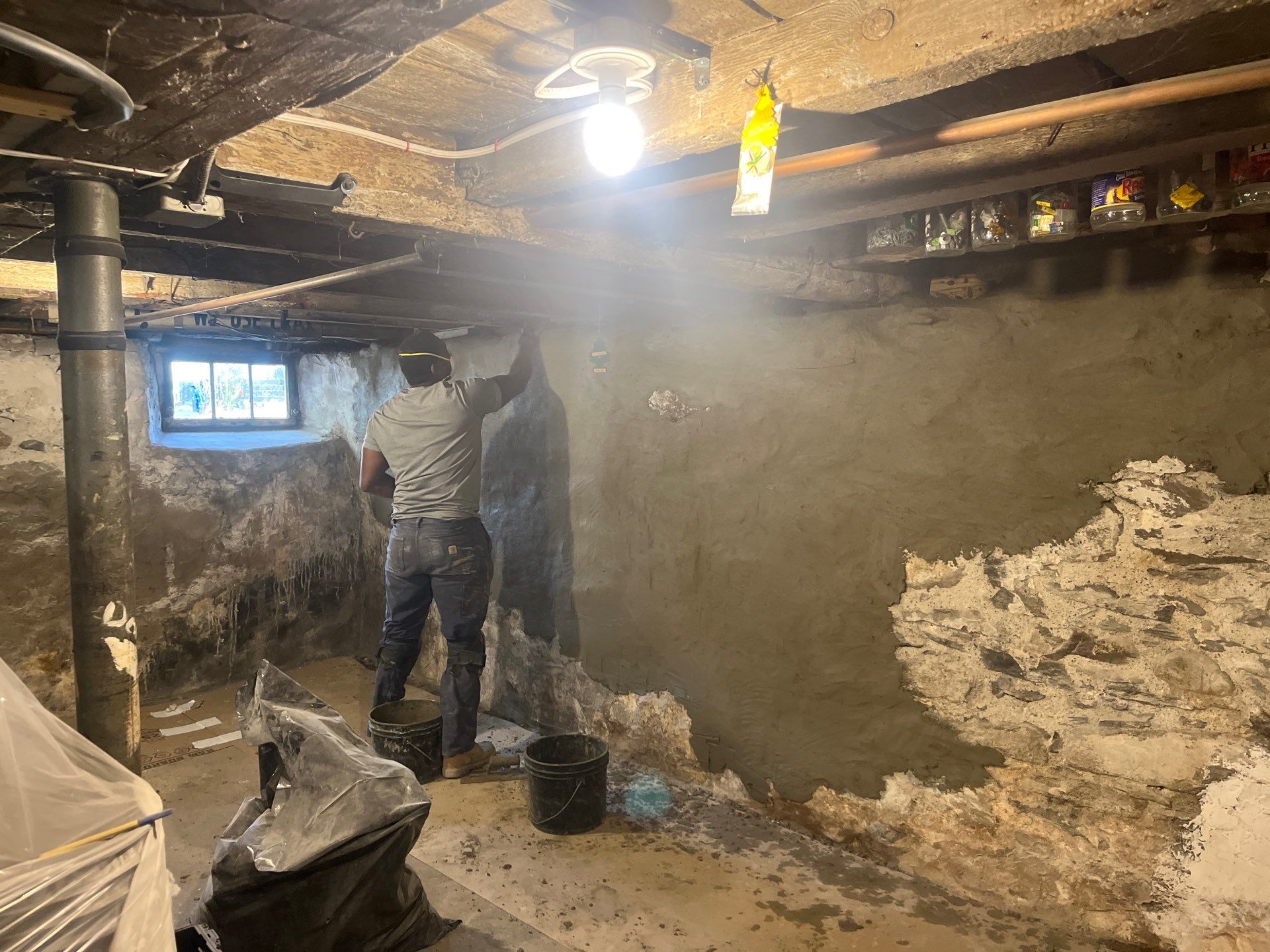
Quick Summary: Fieldstone foundations are common across eastern Massachusetts and Rhode Island, and Drycrete Waterproofing has been repairing them for over 30 years. The work is done different on every house because the condition of the mortar, the source of the water, and the degree of deterioration all vary. Some walls need repointing where the joints have failed. Others need resurfacing or crystalline waterproofing on the masonry that forms a barrier within the wall itself. A free on-site assessment determines which approach fits, and with over 11,000 completed projects and an A+ BBB rating, Drycrete has the track record to back whatever they recommend.
Why Fieldstone Foundations Leak in Massachusetts and Rhode Island
If your home was built before 1930, there’s a reasonable chance it’s sitting on a fieldstone foundation. Walk into the basement of an older colonial in Dedham, a Victorian in Providence, or a farmhouse in Walpole, and you’ll often find the same thing: a wall made of rounded stones held together with mortar, darkened with age, and in many cases, damp. For homeowners in Massachusetts and Rhode Island, a leaking fieldstone foundation is one of the more common problems that comes with older housing stock, and one of the more misunderstood.
The instinct for many homeowners is to treat it like any other basement leak. But fieldstone foundations behave differently than poured concrete or concrete block, and understanding why they leak is the first step toward addressing the problem correctly.
What Is a Fieldstone Foundation?
Fieldstone foundations were the standard construction method across New England for most of the 18th and 19th centuries, and they remained common well into the early 20th. Builders used whatever stone was available on or near the property, typically granite, limestone, or other locally sourced rock, and set it in place with a mortar mix made from lime, sand, and water. The result was a foundation that was durable enough to last well over a century, but one that was never engineered to be watertight.
Unlike poured concrete, which forms a continuous barrier, a fieldstone wall is essentially a stacked assembly of irregular shapes bound together at the joints. The stones themselves are dense and largely impermeable, but the mortar between them is not. Original lime-based mortar is softer and more porous than the portland cement mortars used in modern construction, which is part of what allowed it to flex slightly with seasonal ground movement without cracking catastrophically. That flexibility came at a cost, though. Over decades, water works its way into those joints, and the mortar gradually deteriorates.
Homes across eastern Massachusetts and Rhode Island still have these foundations in large numbers. In older communities like Newton, Norwood, Bristol, and Barrington, it’s more common than not for a pre-1930 home to have some form of stone foundation below grade. For many homeowners, this is simply what the house came with, and the foundation has been there long enough that its condition has never been closely examined.
Why Fieldstone Foundations Leak
The mortar joints are where the problem almost always starts. Lime-based mortar is naturally porous, and over time water infiltrates those joints, expands when it freezes, and contracts when it thaws. In New England, where a single winter can bring dozens of freeze-thaw cycles, that process repeats itself season after season. The mortar gradually softens, crumbles, and pulls away from the stones, leaving gaps that range from hairline to wide open.
Once those gaps form, water doesn’t need much of an invitation. Groundwater pushing against the exterior of the foundation, surface water pooling near the base of the house, and humidity migrating through the wall itself can all find a path through deteriorating joints. The stones themselves are dense and largely impermeable. The mortar holding them together is not.
Age compounds everything. A foundation that has stood for a hundred years has been through a hundred winters, and most lime-based mortar in New England is well past its functional lifespan. Settlement adds further stress. As soil shifts beneath and around the foundation over decades, the wall moves in ways it wasn’t designed to accommodate, opening new gaps and widening existing ones.
Warning Signs MA and RI Homeowners Should Watch For
Fieldstone foundations rarely fail all at once. The deterioration happens gradually, and the early signs are easy to dismiss as normal basement quirks, especially in an older home. These are the conditions worth taking seriously.
- White or gray powder on the stone face. This is efflorescence, a mineral deposit left behind when water moves through the wall and evaporates on the interior surface. It doesn’t cause structural damage on its own, but it’s a reliable indicator that water is actively moving through the foundation.
- Crumbling or missing mortar between the stones. If you can press your finger into the joint material or see gaps where mortar has fallen away entirely, the wall has lost a significant portion of its water resistance. This is the most direct sign that repointing is needed.
- Damp or wet walls after rain or snowmelt. Water appearing on the interior face of the foundation shortly after a weather event points to active infiltration through the joints or the wall assembly itself.
- A persistent musty smell in the basement. Moisture moving through a fieldstone wall doesn’t always produce visible water. Chronic humidity from slow seepage is enough to create the conditions for mold and the odor that comes with it.
- Cold air coming through the basement walls in winter. Gaps in deteriorated mortar joints don’t just let water in. They allow outside air to pass through as well, which shows up as drafts or unexplained cold spots in the lower level of the home.
- Visible gaps or daylight between stones. In more advanced cases of deterioration, the mortar has failed enough that the wall assembly itself has shifted. This warrants prompt attention from a specialist.
Any one of these conditions is worth having evaluated. Several appearing together usually means the foundation has been losing the battle with moisture for some time.
How Fieldstone Foundations Are Waterproofed
Waterproofing a fieldstone foundation isn’t a single fix. Because the wall is a composite of stone and mortar rather than a continuous poured surface, the right approach depends on the condition of the mortar joints, how much water is getting through, and where it’s entering. Drycrete addresses stone foundations through several methods, sometimes individually and sometimes in combination.
Repointing is often the starting point when mortar deterioration is the primary issue. The process involves removing damaged or crumbling mortar from the joints and replacing it with fresh material that restores the wall’s integrity and reduces the pathways water uses to get through. For foundations where the stone assembly is still structurally sound but the joints have failed, repointing can make a significant difference in how the wall handles moisture.
Resurfacing takes the repair a step further. Rather than addressing individual joints, the interior face of the foundation wall is covered with a new layer of material that creates a more uniform and water-resistant surface. This is a practical option for walls where the mortar has deteriorated broadly and repointing alone wouldn’t provide adequate coverage.
Patching addresses localized damage, areas where stones have shifted, mortar has failed in a concentrated section, or previous repairs have broken down. It’s often part of a broader scope of work rather than a standalone solution.
Crystalline waterproofing application works differently than the methods above. A crystalline compound is applied directly to the masonry surface, where it penetrates the material and reacts with moisture to form crystals within the pores and capillaries of the wall. Over time this creates a barrier within the wall itself rather than on its surface, which is particularly effective for stone and masonry that continues to experience groundwater pressure.
A free on-site assessment is the only reliable way to determine which combination of approaches is right for a given foundation. The condition of the mortar, the age of any previous repairs, and the source and volume of water intrusion all factor into what a specialist will recommend.
Schedule a Free Assessment for Your Stone Foundation
Fieldstone foundations are manageable, but they don’t improve on their own. Mortar that has been deteriorating for years won’t stabilize without intervention, and the longer water finds a path through the wall, the more work it does to the surrounding soil, the interior surfaces, and the structure above.
Drycrete Waterproofing has worked on stone foundations across Massachusetts and Rhode Island for over 30 years, and carries an A+ rating with the Better Business Bureau. Every assessment is free, and a specialist can evaluate the condition of your foundation and walk you through what the repair scope actually looks like before any work begins.Request a free quote from Drycrete Waterproofing and find out what your foundation needs before another New England winter puts it to the test.